

The bar has been raised
BREEAM Refurbishment and Fit-Out V7 is now open for registration, and it asks more of refurbishment projects than RFO 2014 ever did. To understand what that means in practice, our assessors re-scored five recent projects against the new standard. The headline is clear: Very Good and Excellent are still achievable under V7, but only for projects that plan for them from the outset. Early strategy setting, not luck, will decide the rating.
What our analysis shows
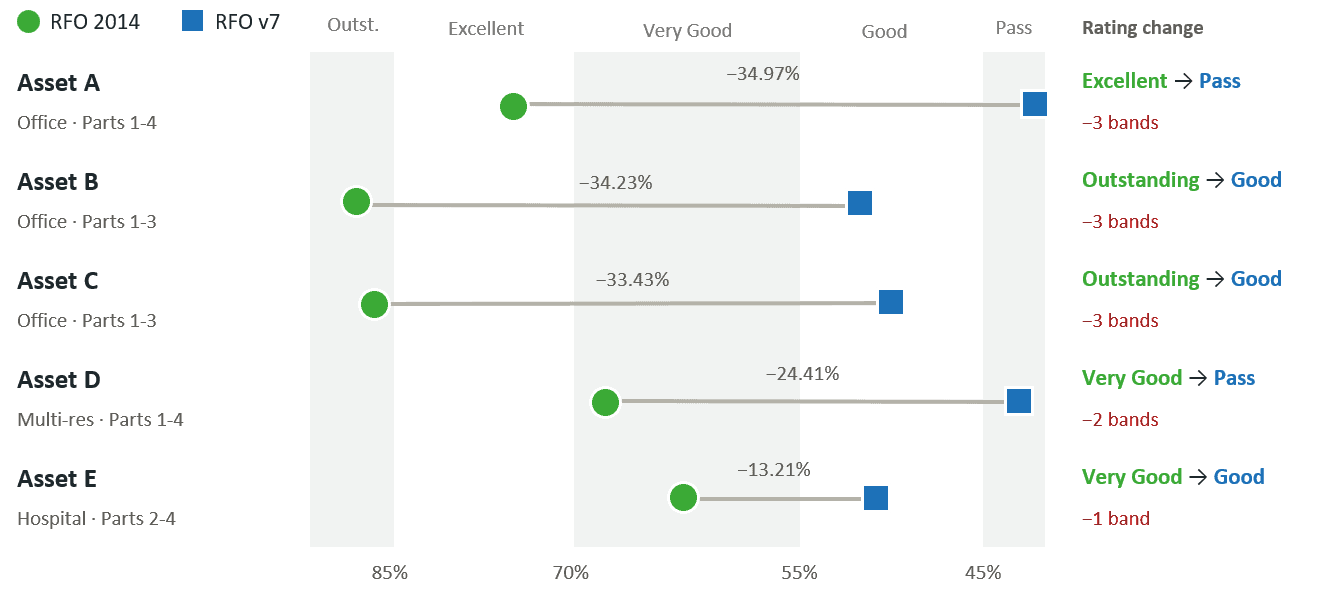
We compared five assets, each assessed under RFO 2014, against the V7 criteria using the same project scope. Every asset scored lower under V7, by between 13 and 35 percentage points, with an average fall of 28.1 points. None reached Very Good on its current design.
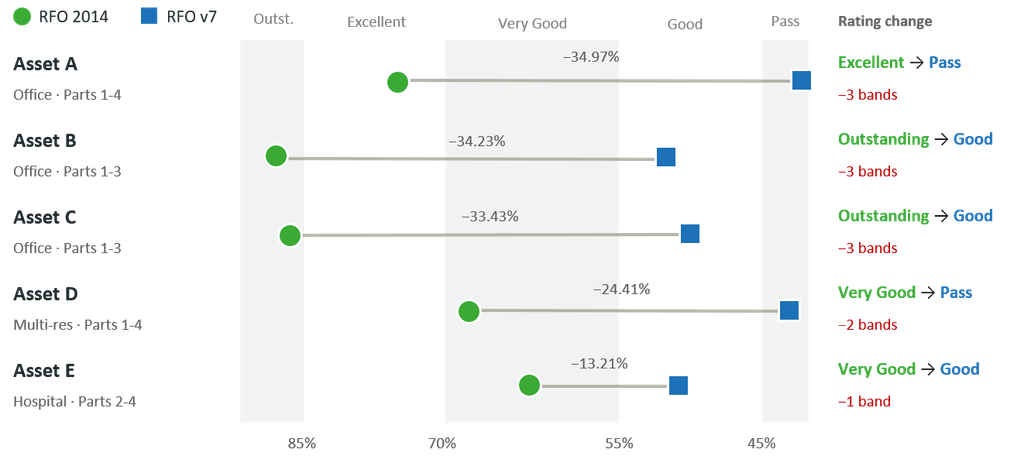
This is not a sign that these buildings have got worse. It reflects a scheme that now rewards different things, and V7 brings genuine improvements:
- Separate routes for different project types: BREEAM Refurbishment V7 and BREEAM Fit-Out V7.
- Credits for real operational performance, not just design intent.
- All-electric schemes now pick up more credits.
- Closer alignment with BREEAM New Construction V7, giving owners one consistent language across a portfolio.
The drop comes mainly from new and tougher areas: the new Resilience category, where few credits are currently being achieved, and the new Energy credits, where scoping is still being clarified. Both are winnable, but they depend on decisions made early in design.
Very Good and Excellent: achievable, with the right strategy
The projects in our sample were designed with RFO 2014 in mind. Under V7, many credits hinge on choices made at concept stage, such as whole life carbon assessment, operational energy targets and resilience measures. When those choices are left late, the credits are lost.
The commercial case for getting this right is strong. Very Good and Excellent ratings are a threshold commonly referenced in planning policy, investor ESG policies and occupier requirements. Falling short can affect lettability, financing terms and asset value, while the measures V7 rewards should cut operating costs and reduce future climate risk.
The single most effective step is to appoint a BREEAM Assessor or Accredited Professional early, ideally before the end of Stage 1. That gives the team time to set a target, map the credits and build them into the brief rather than retrofitting them later. It also allows for ‘easy wins’ and ensuring ‘early action’ requirements are not missed.
How Envision can help
Our BREEAM RFO Assessors have been working through the V7 manuals since their release in July. We can support your project in a number of ways.
- A clear route to Very Good or Excellent. We start with an early pre-assessment and credit-by-credit gap analysis. This identifies the most cost-effective and applicable route to your target rating and highlights the decisions your design team needs to make, and when.
- Technical support across the new requirements. Alongside the assessment itself, our in-house team can deliver the technical studies V7 calls for, predictive energy modelling, whole life carbon assessments, life cycle costing, climate resilience assessments, daylight and thermal comfort analysis and post-occupancy evaluation. One team keeps the strategy joined up and the programme on track.
- Guidance for your wider team. We run CPD sessions on the V7 changes for planners, developers, design teams and contractors. They cover what’s new, where credits are commonly lost and how to plan for them. Get in touch to book a session for your office.
Already planning a refurbishment? Register under RFO 2014 now
RFO 2014 closes to new registrations on Jan 27, 2027. Projects registered before then can still be assessed under the 2014 scheme, with five years to submit for certification.
For projects already designed around RFO 2014, registering now can protect the target rating and avoid redesign.
We can review your pipeline, advise which projects would benefit and handle registration before the window closes.
Talk to us
Whether you’re starting a new refurbishment, mid-design or weighing up an early registration, a short conversation now can make the difference between Pass and Excellent. Contact the Envision BREEAM team at contact@envisioneco.com to arrange a pre-assessment, a pipeline review or a CPD session.
LinkedIn summary text –
BREEAM RFO V7 has raised the bar for refurbishment projects. We re-scored five recent assets against the new standard: scores fell by 13–35 points, and none reached Very Good on its existing design.
The good news? Very Good and Excellent are still achievable. It just takes an earlier, clearer strategy.
In our latest article we look at what’s changed and how we’re helping clients through it, from early credit strategy and technical support to CPDs for project teams.
Planning a refurb? RFO 2014 closes to new registrations on 27 January 2027, so there’s still time to register existing projects.
Other Articles
October 13, 2026
BREEAM In-Use in the Industrial Sector: Its Importance and Role in Sustainability
What is BREEAM In-Use? BREEAM (Building Research Establishment Environmental Assessment Method) In-Use (BIU) is an online assessment…

September 11, 2026
Envision Carbon Impact Report 2025-2026
Our Carbon Footprint Report for the financial year 2025-26 is now finalised and marks our fourth full…

July 21, 2026
Using CRREM Analysis to Manage Real Estate Transition Risk
Real estate owners are facing increasing pressure from regulators, lenders, and occupiers to align their portfolios with…