

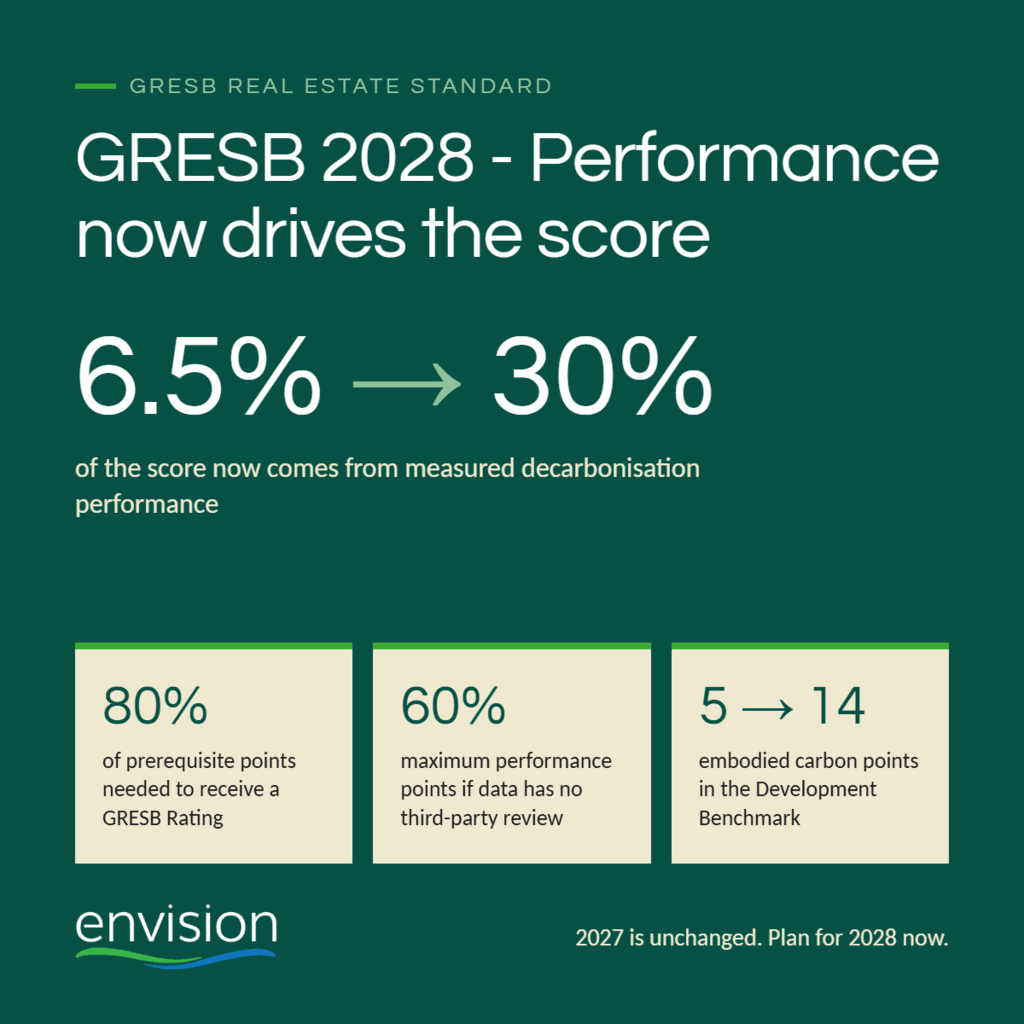
Earlier this month, GRESB published the new 2028 Real Estate Standard, the first step in its multi-year “Road to Performance” programme. As we’ve been advising our clients recently, this new standard sets a clear direction for scores to increasingly reflect how buildings actually perform, not just how they are managed. Measured energy and carbon performance jumps almost fivefold, from 6.5% to 30% of the score, so portfolios that have scored well on policies alone could see their scores fall. GRESB’s long-term ambition is for 50–75% of the score to be performance-based.
The Standard will now be updated on a three-year cycle. This gives managers stability and early visibility of scoring, so they can plan against known targets. Katie Upton, GRESB Accredited Professional at Envision, unpacks the key changes and provides more insight into what they mean for your portfolio.
Key takeaways
- Decarbonisation performance at the core of the Standard. Measured energy and GHG performance rises from 6.5% to 30% of the GRESB Score, scored on both absolute performance and improvement.
- Management basics become prerequisites. Seventeen foundational indicators move outside the score. Entities need 80% of the prerequisite points to receive a GRESB Rating. The indicators cover commitments, governance, policies, risk assessments, stakeholder engagement and monitoring.
- Data quality is now a score driver. Measured data without independent review keeps only 60% of its performance points. To be scored on measured data, an asset needs at least 75% area coverage and a full year of data (355+ days).
- Certifications count for less. Their weight falls from 8.5 to 4 points, with higher ratings earning more.
- Four new topics. Biodiversity, refrigerants, grid interactivity and a new Innovation aspect are worth 10.25 points combined.
- Reporting gets lighter. Prerequisites are reported every three years, and GHG emissions no longer need to be reported.
- Greater visibility over future scoring. Benchmarks for energy, water, waste and certifications are fixed for each three-year cycle, so targets are known in advance.
- Embodied carbon becomes a key focus for developers. In the Development benchmark, embodied carbon rises from 5 to 14 points, with asset-level reporting. Embodied carbon targets (DT1), previously unscored, now carry 3 points.
A closer look at the key changes
Renewable tariffs alone are not enough
Decarbonisation performance is now worth 30 points across three levers: energy efficiency (17 points), on-site combustion and zero-carbon electricity, each scored on both absolute performance and improvement. Greenhouse Gas emissions are no longer scored directly; 13 points are split between on-site combustion and zero-carbon electricity according to grid carbon intensity and climate zone. In heating-dominated climates with cleaner grids, the focus is on-site combustion. For a London asset, GRESB’s illustrative split gives 10 points to on-site combustion and just 3 to zero-carbon electricity. While an asset is still heated by gas, a renewable tariff alone won’t recover most of those points.
Assets don’t need to hit the targets straight away to score. Improvement is rewarded too, measured as an annualised rate over up to four years, so electrification work already underway can still count. In practice, that means building a phased electrification plan for gas-heated assets, and checking that renewable contracts meet GRESB’s new integrity tests: a market-based claim, from the same electricity market, generated in the same year.
Unreviewed data loses 40% of its points
Data coverage and third-party review no longer earn points directly but act as multipliers. Measured data without independent review keeps only 60% of its performance points. Third-party assured or verified data keeps full points. With 30 points now riding on decarbonisation performance, unassured data could cost a portfolio up to 12 points. In practice, that means appointing an independent assurance provider early, working to a recognised standard such as ISO 14064-3, and getting metered data, coverage records and supporting evidence in order before the review begins, so that 2027 data is assured in time for the 2028 submission.
Building certifications: higher ratings now weighted
Higher ratings in building certifications earn a higher proportion of the points (although noting maximum points are less than current, as explained above). For example:
- BREEAM In-Use – Acceptable (0.17) to Outstanding (1.00).
- BREEAM New Construction – Pass (0.20) to Outstanding (1.00).
Floor area coverage is scored linearly against sector and country benchmarks, published in GRESB Guides and fixed for each three-year cycle, which will provide greater transparency over future scoring.
Four new topics worth 10.25 points
- Biodiversity and Nature:
- An update to RM7. Entities are assessed for having a portfolio-level biodiversity and nature-related strategy, worth 2.25 points, with an additional 1 point available where this is aligned with an external framework such as TNFD.
- Refrigerants:
- Up to 2 points available for management of refrigerant stock, from inventory and leak tracking to a dated plan to phase out high-GWP refrigerants.
- Grid interactivity:
- Up to 2 points available for practices such as ability to shift or shed demand, from tracking peak demand to automatic response to price or carbon signals.
- Innovation:
- 3 points available for practices not yet captured by the standard, including innovation in strategy, management, or measured performance.
What to do now
The 2027 Standard is unchanged, but managers should start preparing for 2028 now. The 2028 assessment will use data from 2024 to 2027, so much of the window is already fixed. The priority is completing and assuring 2027 data, and strengthening the evidence behind earlier years. In parallel, plan the retrofit, electrification and procurement work that will drive scores in 2029 and beyond.
Recommended next steps:
- Run a gap analysis against the new prerequisites. Confirm level of achievement against the 17 indicators and the 80% threshold.
- Map data quality by asset. Record measured coverage, review status and any assets that will need the simulation pathway.
- Prioritise assurance where measured data is already complete. It is the fastest route to recovering performance points.
- Build an electrification roadmap for gas-heated assets.
- Test renewable contracts against the three integrity requirements: market-based claim, same market and same-year vintage.
- Rethink certification strategy. Target higher levels where certification adds asset value, rather than broad minimum-level coverage.
- Require embodied carbon assessments. For new developments, include requirement for developers and contractors to carry out embodied carbon assessments (WLCA) and consider setting targets aligned with the Net Zero Carbon Building Standard (NZCBS).
Want to know where your portfolio will land under the new 2028 Standard? Envision can model your indicative score now, while there is still time to act on it. Our expertise covers GRESB data management, data assurance, building certifications, embodied carbon, decarbonisation strategy, and TNFD reporting. Get in touch with contact@envisioneco.com to find out where you stand.
Other Articles
October 23, 2026
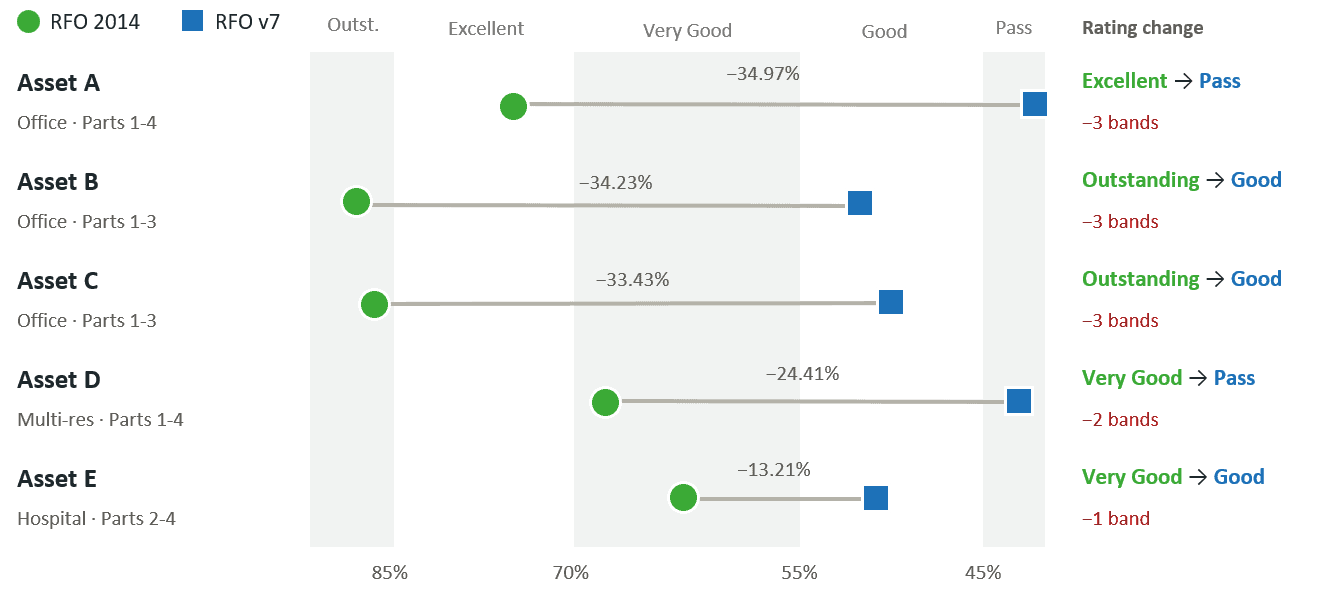
BREEAM Refurbishment and Fit Out (RFO): The impact of v7
The bar has been raised BREEAM Refurbishment and Fit-Out V7 is now open for registration, and it…

October 13, 2026
BREEAM In-Use in the Industrial Sector: Its Importance and Role in Sustainability
What is BREEAM In-Use? BREEAM (Building Research Establishment Environmental Assessment Method) In-Use (BIU) is an online assessment…

September 11, 2026
Envision Carbon Impact Report 2025-2026
Our Carbon Footprint Report for the financial year 2025-26 is now finalised and marks our fourth full…